

Drive Flashback: 1967 Shelby Mustang GT500
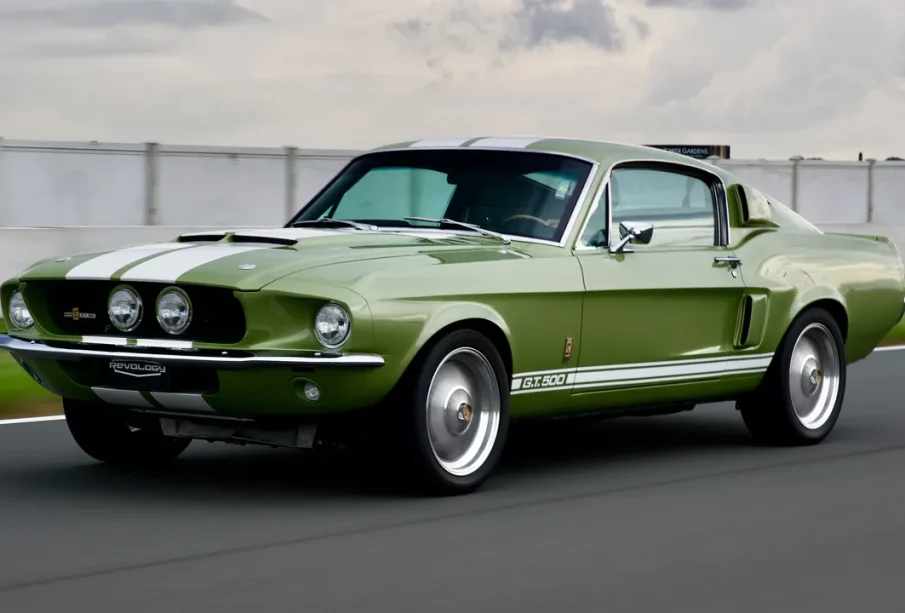
The 1967 Shelby Mustang GT500 was a landmark in the performance cars of America- a combination of crude strength and a sophisticated design to come up with a muscle car that was not similar to other Mustang models.
Unique Hairstyling and Image.
The 1967 GT500 was stylishly different and far more dramatic in contrast to the ordinary Mustang, and the History of the 1967 Shelby GT500 is closely tied to these bold design choices. The traditional chrome grille was replaced at the front end with a redesigned nose featuring a pronounced scoop and exposed mesh, flanked by closely set headlights inspired by rally cars. The fiberglass hood incorporated a functional air scoop and a distinctive bulge, giving the car a focused and muscular stance. Along the sides, dual scoops increased airflow, with some channeling air into cockpit vents and others cooling the rear brakes. At the rear, four wide taillights and a ducktail trunk lid helped the GT500 stand apart from the mainstream fastback, giving it a purposeful and aggressive appearance.
Inside and Elementary Brushes.
The interior had the GT500 which was a slightly modified version of the standard Mustang cabin featuring functional additions and not a full redesign. The roll bar was fitted with inertia-reel shoulder straps, further enhancing safety and still making the rear seating area handy, unlike in the previous two-seater cars of Shelby. The original Mustang seats and dashboard were still used with other gauges added like an ammeter and oil pressure gauge. The steering wheel with the Shelby emblem was stylish, having a wood rim and ergonomic features that did not decrease practicality.
Suspension and Handling
Shelby was designed to be firmer than a standard Mustang, but not as firm as some previous Shelby models. It had stiffer springs in front and the rear and an anti-roll bar that was bigger in the front and adjustable shocks in all four positions. Rubber snubbers at the rear of the axle contributed to the suppression of axle wind-up and the hop without the harsh ride of earlier systems. The whole arrangement made the GT500 have a confident and predictable feel on the road, and it was able to handle well compared to many American cars of the time, with its significantly high curb weight.
Engine, Driving Sensation, and Performance.
The GT500 under the hood was powered by a Ford big-block 428-cubic-inch V-8 a large Police Interceptor engine with two four-barrel carburettors and rated at 355 horsepower. Although physically large and heavy, this power plant provided a large amount of torque and a unique thump that made the GT500 a unique car. The GT500 was also a simple car to operate and it was responsive in real-life situations with the three-speed automatic transmission on the test car. The deep throttle resulted in spectacular exhaust smoke and a violent forward rush, the power steering was needed to cope with the huge front tyres. Although the performance was not the leader in linear acceleration straight line speed performance – with quarter-mile times in the mid-15-second range – the overall combination of power and smoothness in the car was strong at that time.
Motivation, Impression and Personality.
On the highway, the GT500 was more refined than the previous Shelby track cars, and was comfortable at high speeds and provided more of an everyday experience without being a muscle car. The suspension and steering provided unexpectedly good handling which is considered not to happen considering the front-weight concentrate design of the car. Although hard, the ride was thought to be manageable and the GT500 was a muscle car that could be driven on a regular basis but not just when it was on a race day.


